
China and Pakistan foreign ministers agree to launch new economic corridor projects
Wire desk byline Sourced from Xinhua, Dawn, Arab News, Anadolu and Minute Mirror. Translated and abridged by the GSRRA Desk.
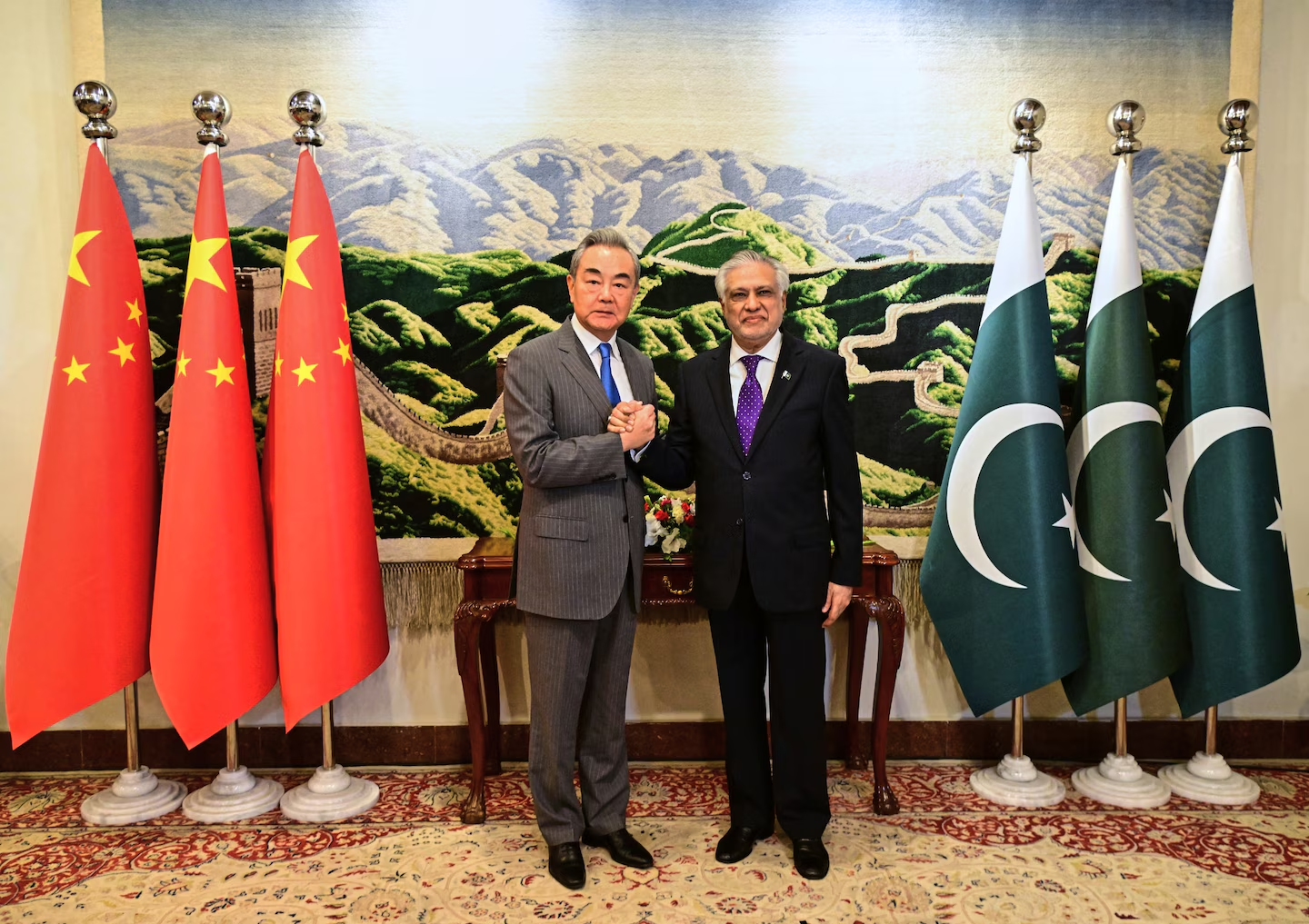
Pakistan and China have pledged to expand economic cooperation and investment under the China-Pakistan Economic Corridor, a flagship program of China’s Belt and Road Initiative
In this photo, released by the Pakistan’s Ministry of Foreign Affairs, Pakistan’s Deputy Prime Minister and Minister of Foreign Affairs Ishaq Dar, right, shakes hand with Chinese Foreign Minister Wang Yi, prior to their meeting in Islamabad, Pakistan, Thursday, Aug. 21, 2025. (Pakistan’s Ministry of Foreign Affairs via AP) (Uncredited/Pakistan’s Ministry of Foreign Affairs)
Pakistan and China pledged to expand economic cooperation and investment under the China-Pakistan Economic Corridor, a flagship program of China’s Belt and Road Initiative , officials said.
Get a curated selection of 10 of our best stories in your inbox every weekend.
Chinese Foreign Minister Wang Yi met with his Pakistani counterpart, Ishaq Dar, at the Ministry of Foreign Affairs in Islamabad on Thursday. The two sides agreed to launch new projects through the China-Pakistan Economic Corridor, or CPEC, a flagship program of the Belt and Road Initiative, a Pakistani government statement said.
The countries did not immediately share details of the proposed projects.
Called “One Belt, One Road” in Chinese, the Belt and Road Initiative has built power plants, roads, railroads and ports around the world and deepened China’s relations with Africa, Asia, Latin America and the Mideast. It is a major part of Chinese President Xi Jinping’s push for China to play a larger role in global affairs.
Beijing has invested billions of dollars in Pakistan through CPEC, building roads, power plants and rail links to connect China’s western Xinjiang region with the Arabian Sea port of Gwadar in southwest Pakistan , where some Chinese have been attacked by insurgents in recent years.
The foreign ministers vowed to deepen collaboration in science, technology, industry and agriculture.
Wang also urged Pakistan to ensure the safety of Chinese workers and engineers, who have come under attack by separatists in Balochistan province and elsewhere in recent years. Pakistan already has increased security for Chinese working on CPEC-related projects.
China has long been one of Pakistan’s key ally and financial backer, especially as Islamabad struggles with a prolonged economic crisis.
The meeting came a day after Wang and Dar traveled to Kabul for a trilateral dialogue with Afghanistan’s Taliban rulers on political and economic cooperation.
Wang’s stop in Pakistan also followed a visit to neighboring India earlier this week, where he held talks aimed at stabilizing strained relations between the two Asian giants.
Reference Link:- https://www.washingtonpost.com/business/2025/08/21/pakistan-china-foreign-ministers-economic-corridor/4a0a74ac-7e83-11f0-971c-6c8e53bd2f21_story.html

Zamir Ahmed Awan is the founder and Chair of the Global Silk Route Research Alliance, a think tank in Islamabad. He studied engineering at Shanghai University in the 1980s, and years later he went back to China as Pakistan's science counsellor in Beijing, from 2010 until 2016, working on science and higher education cooperation between the two countries.…






