

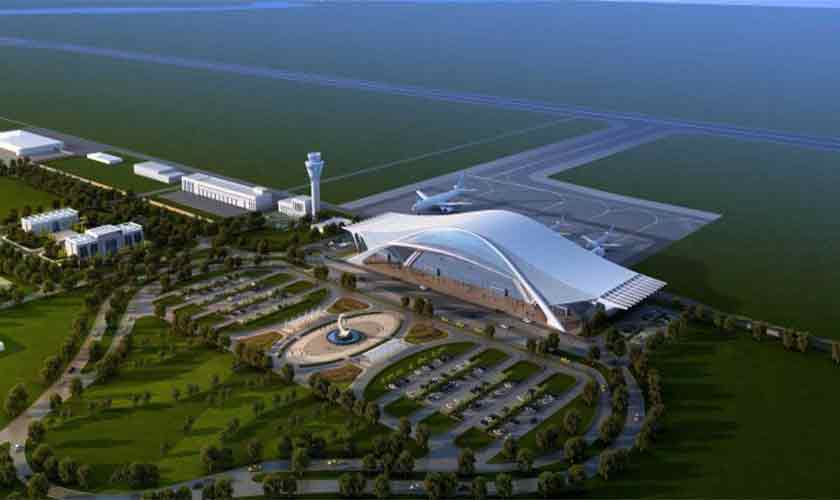
The Gwadar airport is a significant step to make CPEC more viable not only for China and Pakistan but also for the region.
Then Gwadar was re-acquired from Oman in the year 1958, few people realized its full importance. It remained dormant for the next fifty-five years. In 2013 China-Pakistan Economic Corridor was conceived and the development work started.
Gwadar is the jewel in the CPEC crown. It is on its way to gaining further importance globally in general and in the region in particular.
When CPEC was planned, it was meant to join the land route between China and Pakistan to the Arabian Sea. The Gwadar port had been partially developed by Singapore Port Authority but not fully operationalized.
The Singapore Port Authority now passed the project on to China Port Holding Company. On May 16, 2013, COPHC took over the control of Gwadar Port and Gwadar Free Zone for 40 years. The COPHC and its subsidiaries – Gwadar International Terminals Ltd, Gwadar Marine Services Ltd, and Gwadar Free Zone Company Limited – then started the development of facilities required to run the port.
While a part of the land component of the project (roads and bridges) existed, considerable work was needed on the sea component, i.e., Gwadar port and seaward approaches. Three major projects were undertaken for this purpose besides various minor ones. These were the South and North Free Zones, Eastbay Expressway, and New Gwadar International Airport. All these are to improve port operations and connectivity.
A six-lane expressway and a 30-meter-wide railway corridor are to connect the port with the Makran Coastal Highway (N-20) through the 2,281-acre Free Trade Zone. It is an 18.5-kilometer road, including a 14.5-kilometer offshore portion.
The New Gwadar International Airport is one of the biggest airports in Pakistan. Its runway can accommodate airplanes as big as A380. The airport has a terminal and all allied facilities for its smooth operations. Test flights on the runway have been carried out successfully. The airport is set to be operationalized soon. The NGIA will open new vistas of connectivity for Gwadar not only inland but also to other parts of the region.
The operationalization of the Gwadar port is contingent upon the western route being developed. Security impediments to this are currently being removed. Pending the completion of the western route, the NGIA can serve to supplement Gwadar port for the transportation of goods to and from China.
It is now up to the local administration to manage the passenger traffic which is expected to rise especially during winters and reap the benefits of the new facility.
Additionally, it can serve as a conduit for Central Asian Republics, the Gulf, West Asia, and the Far East. Besides, the NGIA can be a strong incentive for those traveling to China. The NGIA has, in fact, added another dimension to the concept of CPEC which is usually considered as a sea, rail, and road network.
The NGIA has added an air component to the CPEC; a significant incorporation to make CPEC more viable for not only China and Pakistan but also for the region and beyond. Pakistan is trying to attract foreign investment and increase its trade volume.
The NGIA is located about 26 kilometers east of Gwadar city. It has an area of 4,300 acres. The airport has been developed under the guidance of the Pakistan Civil Aviation Authority and will be operated under its open-sky policy.
The project missed its original timeline, primarily because of the Covid-19 pandemic. Its construction has been led by Chinese engineers. While Gwadar already had an airport, it was unable to handle large aircraft. Small airplanes could continue to use the airport where the night landing facility was added a few years ago.
These impediments had hindered frequent flights to and from Gwadar. Only PIA operated regularly in the Karachi-Gwadar sector. With the commissioning of the NGIA, other airlines have an incentive to operate flights to other cities of Pakistan.
Adequate lodging facilities are now available in Gwadar. In the past, the number of visitors had been limited on account of the lack of regular flights and the inability to land large planes.
Road travel to Gwadar via Makran Coastal Highway too can be a treat. However, some facilities need to be added to make it reassuring. It is now up to the local administration to manage and facilitate the passenger traffic that is expected to rise especially during winters and reap the benefits of this new facility.
Reference Link:- https://www.thenews.com.pk/tns/detail/1221058-adding-value-to-cpec