

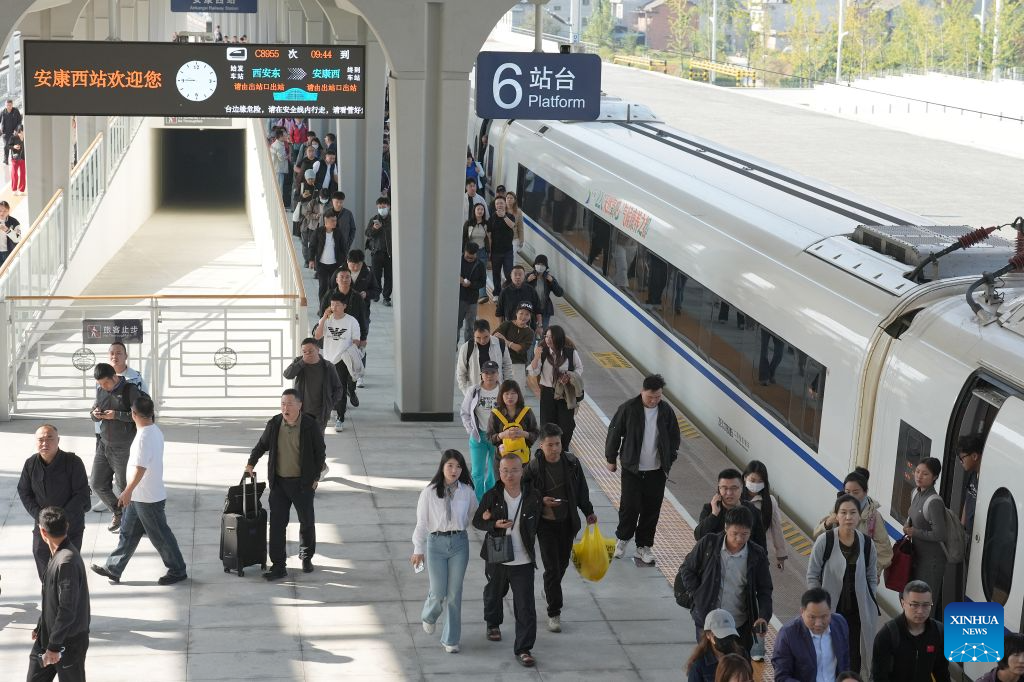

Passengers are pictured at the Ankang West Railway Station in Ankang, northwest China’s Shaanxi Province, Oct. 8, 2026.
The city of Ankang receives a surging number of tourists, thanks to the Xi’an-Ankang high-speed railway officially put into operation on Sept. 28 this year. The travel time between Xi’an, capital of Shaanxi, and Ankang has been slashed to less than one hour. (Xinhua/Shao Rui)

Tourists watch a performance inside a historical guild house in Ziyang County of Ankang, northwest China’s Shaanxi Province, Oct. 3, 2026.
The city of Ankang receives a surging number of tourists, thanks to the Xi’an-Ankang high-speed railway officially put into operation on Sept. 28 this year. The travel time between Xi’an, capital of Shaanxi, and Ankang has been slashed to less than one hour. (Photo by Huang Jie/Xinhua)

Tourists watch a welfare performance on the bank of the Hanjiang River in Ankang, northwest China’s Shaanxi Province, Oct. 7, 2026.
The city of Ankang receives a surging number of tourists, thanks to the Xi’an-Ankang high-speed railway officially put into operation on Sept. 28 this year. The travel time between Xi’an, capital of Shaanxi, and Ankang has been slashed to less than one hour. (Photo by Liu Yang/Xinhua)

An aerial drone photo taken on Oct. 8, 2026 shows the scenery along the Hanjiang River in Ankang, northwest China’s Shaanxi Province.
The city of Ankang receives a surging number of tourists, thanks to the Xi’an-Ankang high-speed railway officially put into operation on Sept. 28 this year. The travel time between Xi’an, capital of Shaanxi, and Ankang has been slashed to less than one hour. (Xinhua/Shao Rui)

An aerial drone photo taken on Oct. 8, 2026 shows a view of the Ankang West Railway Station in Ankang, northwest China’s Shaanxi Province.
The city of Ankang receives a surging number of tourists, thanks to the Xi’an-Ankang high-speed railway officially put into operation on Sept. 28 this year. The travel time between Xi’an, capital of Shaanxi, and Ankang has been slashed to less than one hour. (Xinhua/Shao Rui)

Passengers are pictured at the Ankang West Railway Station in Ankang, northwest China’s Shaanxi Province, Oct. 9, 2026.
The city of Ankang receives a surging number of tourists, thanks to the Xi’an-Ankang high-speed railway officially put into operation on Sept. 28 this year. The travel time between Xi’an, capital of Shaanxi, and Ankang has been slashed to less than one hour. (Xinhua/Shao Rui)

A worker places flowers outside the Ankang West Railway Station in Ankang, northwest China’s Shaanxi Province, Oct. 8, 2026.
The city of Ankang receives a surging number of tourists, thanks to the Xi’an-Ankang high-speed railway officially put into operation on Sept. 28 this year. The travel time between Xi’an, capital of Shaanxi, and Ankang has been slashed to less than one hour. (Xinhua/Shao Rui)
Reference Link:- https://english.news.cn/20261009/5c4910cb1efd4974917c42332012dc16/c.html