

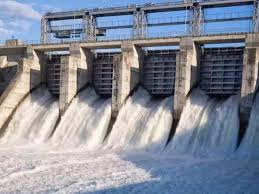
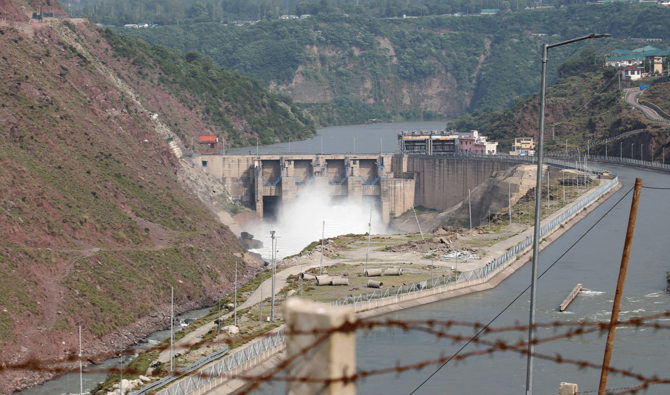
A view of the Uri-II hydroelectric project dam on the Jhelum River which flows from Indian Kashmir into Pakistan-administered Kashmir, near Uri in India-administered Kashmir’s Baramulla district, May 7, 2025. (Reuters/File)
- Projects including Diamer-Bhasha Dam, Mohmand Dam, Kurram Tangi Dam and Nai Gaj Dam are expected to improve water availability
- Pakistan’s water resources are under growing pressure from erratic rainfall and rapidly melting glaciers linked to climate change pressures
Pakistan has accelerated work on four dam projects that are expected to add more than eight million acre-feet (MAF) of water storage capacity, state media reported, as the country seeks to strengthen water security amid growing climate-related challenges.
The projects include the Diamer-Bhasha Dam, Mohmand Dam, Kurram Tangi Dam, and the Nai Gaj Dam, according to the Associated Press of Pakistan (APP). The dams are expected to improve water availability, enhance flood management, and boost hydropower generation capacity.
Pakistan’s water resources are under increasing pressure from erratic rainfall patterns and the rapid melting of glaciers linked to climate change. Officials have repeatedly warned that the country faces a widening gap between water supply and demand, making additional storage infrastructure a national priority.
“Currently, four major projects with a combined live storage capacity of 8.136 MAF are under implementation,” APP said in a report on Saturday.
“These include the strategically important Diamer-Bhasha Dam, which alone will provide 6.4 MAF of storage capacity, along with Mohmand Dam with 0.676 MAF, Kurram Tangi Dam with 0.90 MAF and Nai Gaj Dam with 0.16 MAF.”
Pakistan’s three main reservoirs are Tarbela Dam, with a live storage capacity of 5.580 MAF, Mangla Dam with 7.277 MAF, and Chashma Barrage with 0.311 MAF, it added.
The report highlighted that the Water and Power Development Authority (WAPDA) designated the current period as the “Decade of Dams”, accelerating major water infrastructure projects to bolster water security amid climate change and rising demand.
The report said reservoir projects with a combined live storage capacity of 15.88 MAF were in the planning and design stages, including Sindh Barrage (2.0 MAF), Shyok Dam (5.5 MAF), Akhori Dam (7.0 MAF), Chiniot Dam (0.93 MAF), and Murunj Dam (0.45 MAF).
It added that WAPDA also expanded its hydro-meteorological monitoring and telemetry systems to provide real-time data on river flows, transboundary streams, reservoir levels, and rainfall.
In April, the government said Pakistan had water storage capacity equivalent to about 90 days of demand and announced plans for a high-level task force meeting to address mounting water security concerns.
Last year, Pakistan’s Prime Minister Shehbaz Sharif called for urgent construction of reservoirs and dams after swollen rivers devastated the breadbasket of the country’s most populous Punjab province.
Reference Link:- https://www.arabnews.pk/node/2645567/pakistan