

(下边有中文翻译,请继续看到底。 谢谢。)
Summary
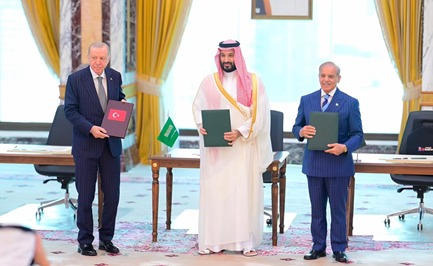
- The Makkah Joint Defence Agreement signed by Pakistan, Saudi Arabia and Türkiye on August 7, 2026, represents more than a security arrangement.
- Pakistan, Saudi Arabia and Türkiye are Muslim-majority countries with deep connections to Islamic history and civilization.
- Pakistan connects the Arabian Sea with South Asia and China; Saudi Arabia sits at the heart of the Gulf and Red Sea; and Türkiye connects the Middle East with Europe, the Caucasus and Central Asia.
The Makkah Joint Defence Agreement signed by Pakistan, Saudi Arabia and Türkiye on August 7, 2026, represents more than a security arrangement. It brings together three influential Muslim-majority states whose geographical positions, economic resources, military capabilities, diplomatic relationships and historical connections are remarkably complementary. The agreement is therefore best understood not as an exclusive military bloc, but as the foundation of a broader partnership for security, stability and shared prosperity. The three governments have explicitly described it as defensive, not directed against any country, and open to other regional states that accept its principles.
The first and most obvious commonality is religious and civilizational affinity. Pakistan, Saudi Arabia and Türkiye are Muslim-majority countries with deep connections to Islamic history and civilization. Makkah itself gives the agreement exceptional symbolic significance. Pakistan and Türkiye have long-standing popular and political sympathy, while Saudi Arabia occupies a unique position as the custodian of Islam’s two holiest mosques. These bonds provide a powerful social
foundation that goes beyond conventional strategic calculations.
There is also substantial convergence of security interests. All three countries face a complex regional environment involving terrorism, transnational crime, instability, cyber threats, maritime insecurity and geopolitical competition. Their security capabilities are complementary rather than identical. Pakistan contributes extensive military experience, a large professional armed force and an advanced defense-industrial base. Türkiye brings a sophisticated defense industry, NATO experience and rapidly expanding capabilities in drones, aerospace, naval systems and military technology. Saudi Arabia contributes substantial financial resources, strategic Gulf geography and growing investment capacity. Together, these strengths can create capabilities that would be difficult for any one partner to develop alone.
The economic argument is equally compelling. Saudi Arabia possesses enormous energy resources and financial capacity and is pursuing industrial diversification under Vision 2030. Türkiye offers manufacturing expertise, industrial capacity, technological capabilities and access to European and Eurasian markets. Pakistan brings a large population, agricultural and human-resource potential, a growing consumer market, strategic access to the Arabian Sea and links with South and Central Asia. World Bank data put the combined populations of Saudi Arabia, Türkiye and Pakistan at more than 378 million, while their economies collectively represent well over $3 trillion in nominal GDP.
This complementarity creates enormous possibilities for trade, investment and industrial cooperation. Saudi capital can support Pakistani and Turkish industrial projects; Turkish technology and manufacturing can contribute to Saudi Arabia’s diversification and Pakistan’s industrial modernization; and Pakistan can provide agricultural products, skilled manpower and access to South Asian markets. Saudi-Turkish trade alone reached substantial levels in 2025, while both countries have identified investment, energy, mining, technology, agriculture, transport and infrastructure as areas for expanded cooperation.
The same logic applies to defense technology. The agreement specifically provides for enhanced defense cooperation, while Türkiye has highlighted joint defense-industry projects and counterterrorism cooperation. Pakistan’s defense expertise and Türkiye’s technological capabilities could combine with Saudi investment to establish joint production, research, training, and maintenance facilities. Such cooperation would strengthen self-reliance while creating skilled employment and technological spillovers.
Geography further strengthens the partnership. Pakistan connects the Arabian Sea with South Asia and China; Saudi Arabia sits at the heart of the Gulf and Red Sea; and Türkiye connects the Middle East with Europe, the Caucasus and Central Asia. Together, the three countries occupy a strategic corridor linking Asia, the Middle East and Europe. Improved ports, railways, logistics networks, energy corridors and digital connectivity could transform the relationship from a defense partnership into a comprehensive economic and connectivity platform.
The pact’s potential expansion is particularly important. Pakistani Foreign Minister Ishaq Dar has said that the agreement remains open to regional countries willing to uphold its principles, while Türkiye has indicated that Egypt could potentially join. This creates room for a wider framework involving countries such as Egypt, Qatar and Bangladesh in the future, provided consensus can be achieved.
The agreement has also received a positive response from the Organization of Islamic Cooperation, whose secretary-general welcomed it as a step toward stronger security and cooperation in the Muslim world. At the same time, the pact already enjoys formal endorsement from the UN, the United States, China, Russia and Europe.
Most importantly, the Makkah Pact should remain inclusive rather than confrontational. Pakistan has stressed that it is consistent with Article 51 of the UN Charter, does not replace existing alliances and is not directed against any particular country. The agreement’s first institutional meeting has already taken place, demonstrating that the initiative is moving beyond symbolism toward an organized framework.
The Makkah Pact’s greatest promise, therefore, lies not simply in collective defense. Its real historic potential is to transform shared faith, complementary capabilities and strategic geography into shared prosperity. If its members institutionalize economic cooperation alongside security coordination, the pact could become a durable platform for investment, technology transfer, industrialization, connectivity and regional peace. What begins in Makkah as a partnership among three countries could, with patience and responsible diplomacy, develop into a wider framework of cooperation across the Muslim world.
麦加协议:一个具有广泛区域潜力的天然伙伴关系。
2026年8月7日,巴基斯坦、沙特阿拉伯和土耳其签署的《麦加联合防御协议》远不止是一项安全安排。该协议汇聚了三个具有重要影响力的穆斯林多数国家,它们在地理位置、经济资源、军事实力、外交关系以及历史联系方面均展现出显著互补性。因此,这一协议不应被理解为一个排他性的军事联盟,而应被视为建立在安全、稳定与共同繁荣基础上更广泛伙伴关系的基石。三国政府明确表示,该协议具有防御性质,不针对任何特定国家,并向其他接受其原则的地区国家开放。
首要且最明显的共同点是宗教与文明上的亲缘关系。巴基斯坦、沙特阿拉伯和土耳其均为穆斯林多数国家,与伊斯兰历史和文明有着深厚渊源。麦加本身赋予了该协议非凡的象征意义。巴基斯坦与土耳其长期保持着民众与政治层面的密切共鸣,而沙特阿拉伯则作为伊斯兰两大圣寺的守护者,占据着独特地位。这些纽带构成了强大的社会纽带
超越传统战略考量的坚实基础。
三国在安全利益上也存在显著趋同。这三个国家都面临复杂的地区环境,包括恐怖主义、跨国犯罪、不稳定局势、网络威胁、海上安全问题以及地缘政治竞争。它们的安全能力相互补充,而非完全相同。巴基斯坦拥有丰富的军事经验、庞大的专业武装力量和先进的国防工业基础;土耳其则具备成熟的国防工业、北约经验,以及在无人机、航空航天、海军系统和军事技术领域快速扩展的能力;沙特阿拉伯则贡献了大量资金资源、具有战略意义的海湾地理优势以及不断增长的投资能力。这些优势的结合,能够形成任何单一伙伴难以独自构建的能力。
经济方面的论点同样令人信服。沙特阿拉伯拥有巨大的能源资源和雄厚的财政实力,并正通过“2030愿景”推进产业多元化;土耳其则提供制造专业知识、工业产能、技术能力,以及进入欧洲和欧亚市场的渠道。巴基斯坦拥有庞大的人口、农业和人力资源潜力、不断增长的消费市场,以及通往阿拉伯海的战略通道,并与南亚和中亚地区保持紧密联系。根据世界银行的数据,沙特阿拉伯、土耳其和巴基斯坦的总人口超过3.78亿,其经济名义GDP总额合计超过3万亿美元。
这种互补性为贸易、投资和工业合作创造了巨大机遇。沙特资本可支持巴基斯坦和土耳其的工业项目;土耳其的技术和制造业有助于沙特阿拉伯实现多元化发展,同时推动巴基斯坦的工业化现代化;而巴基斯坦则可提供农产品、技术工人以及进入南亚市场的渠道。2025年,沙特与土耳其之间的贸易额已达到可观水平,两国均将投资、能源、矿业、科技、农业、交通和基础设施列为深化合作的重点领域。
同样的逻辑也适用于国防技术领域。该协议特别强调加强国防合作,同时土耳其也重点推进了联合国防工业项目和反恐合作。巴基斯坦的国防技术专长与土耳其的技术能力相结合,并辅以沙特的投资,可共同建立联合生产、研发、培训和维护设施。此类合作将增强自主性,同时创造高技能就业机会并带来技术溢出效应。
地理因素进一步巩固了这一伙伴关系。巴基斯坦连接阿拉伯海与南亚及中国;沙特位于海湾和红海的核心地带;土耳其则连接中东与欧洲、高加索地区及中亚。三国共同占据着连接亚洲、中东与欧洲的战略走廊。港口、铁路、物流网络、能源走廊以及数字互联的改善,有望将双方关系从单纯的防务合作提升为全面的经济与互联互通平台。
该协议的潜在扩展尤为重要。巴基斯坦外长伊沙克·达尔表示,该协议仍对愿意遵守其原则的地区国家开放,而土耳其则表示埃及可能加入。只要达成共识,未来还有望扩大框架,涵盖埃及、卡塔尔和孟加拉国等国家。
该协议也获得了伊斯兰合作组织的积极回应,其秘书长表示,这是迈向穆斯林世界更强大、更安全与合作的重要一步。与此同时,该协议已获得联合国、美国、中国、俄罗斯和欧洲的正式支持。
最重要的是,麦加协议应保持包容性而非对抗性。巴基斯坦强调,该协议符合《联合国宪章》第51条,不取代现有联盟,也不针对任何特定国家。协议的首次机构会议已经举行,表明这一倡议正超越象征意义,逐步走向有组织的框架。
因此,麦加协议最大的潜力并不在于集体防卫本身,而在于将共同信仰、互补能力与战略地理转化为共同繁荣。如果各成员在加强安全协调的同时,将经济合作制度化,该协议有望成为投资、技术转让、工业化、互联互通和区域和平的持久平台。始于麦加的三国合作,若能以耐心和负责任的外交手段推进,有望发展为覆盖整个穆斯林世界的更广泛合作框架。
(注意: 本文是用AI翻译的,或有误差。请以原版英文为准。谢谢。)
Reference Link:- https://minutemirror.com.pk/the-makkah-pact-a-natural-partnership-with-wider-regional-potential-627258/