

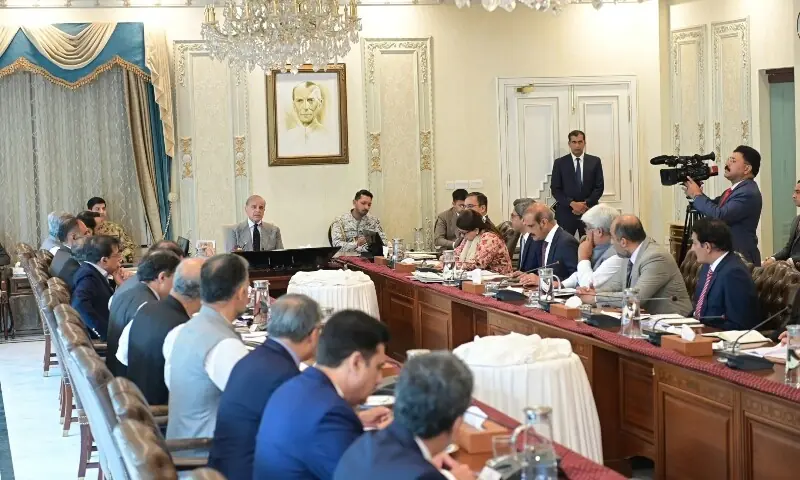

Prime Minister Shehbaz Sharif on Saturday ordered the installation of “smart scanners” at all international airports to facilitate travellers, according to a statement from his office.
The premier issued these instructions during a meeting reviewing the customs enforcement in Islamabad, attended by Deputy Prime Minister and Foreign Minister Senator Muhammad Ishaq Dar, as well as Federal Ministers Azam Nazeer Tarar, Dr Musadik Malik, Ahad Khan Cheema and Attaullah Tarar.
PM Shehbaz ordered that the scanners be immediately imported and that, once installed, baggage should be screened with the new technology as opposed to being searched manually by customs officials.
According to the statement, he also issued directives for customs officials, saying that passengers must not be harassed through unnecessary questioning at airports.
“The prime minister further stated that outdated procedures for screening passengers’ baggage at airports must be abandoned. Passenger convenience and comfort are the top priority, and no one will be allowed to harass passengers,” the statement read.
The Prime Minister’s Office (PMO) added that an “internationally established automated system will be introduced for baggage screening” and that staff providing other services at airports would be trained in line with international standards.
“Courtesy and respect for human dignity in service delivery must be key components of the training,” the statement added.
Commending a new enforcement system introduced by the Customs department, the premier said the initiative deserved appreciation, crediting Federal Board of Revenue (FBR) Chairman Rashid Mahmood Langrial and his team.
He stressed that every possible step must be taken to curb revenue leakage, reiterating a policy of zero tolerance against tax evasion.
“Tax-paying businesses are respectable, while tax evaders will face strict action. We are custodians of the poor man’s money and will protect it at all costs,” he remarked.
Reviewing the customs system, the premier was briefed on the movement of goods and monitoring at various locations nationwide, and the performance of the Customs Enforcement Force and measures to prevent the smuggling of petroleum products.
“The meeting was informed that significant progress had been made in establishing and operationalising Digital Enforcement Stations under Customs Enforcement,” the PMO said, adding that the Indus Collectorate, in its first three weeks of operation, executed 80 operations and seized goods worth approximately Rs205 million.
“A total of 865 personnel had been deployed, covering 26 major transit routes,” it added.
With operations ongoing against smuggled textiles, vehicles, cigarettes and other goods, 280 goods valuers had been recruited and would be trained this month and in November, the statement read.
“The meeting was also informed that, as a result of the FBR’s reforms to prevent smuggling, the customs enforcement system had been consolidated into a single, coordinated organisation operating nationwide,” it added.
Reference Link:- https://www.dawn.com/news/2036166