

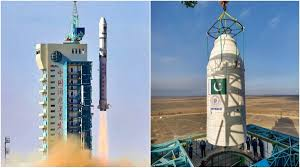

Pakistan launched the PRSC-EO3 earth observation satellite on 25 April 2026 aboard a Long March 6 rocket from China’s Taiyuan launch centre, completing the three-satellite electro-optical series under the Space and Upper Atmosphere Research Commission’s (SUPARCO) Space Vision 2040 program.1 What has drawn attention is not the launch but the orbit. Tracking data from the US space situational awareness firm COMSPOC, reported by ThePrint, places EO-3 at a 38-degree inclination, roughly 554 km up, with a Right Ascension of Ascending Node (RAAN) of 334 degrees.2 Every other satellite in Pakistan’s recent fleet flies a conventional sun-synchronous orbit (SSO) near 97 to 98 degrees, including PAUSAT-1 at 97.4 degrees and PRSS-1 at roughly 97.9 degrees.3 The 38-degree figure is the outlier, and COMSPOC’s reading is that it trades global coverage and consistent lighting for sharply higher revisit over the 20-to-40-degree-north band that takes in Pakistan, northern India, and the Kashmir theatre.2
Indian analysts have taken that configuration as evidence of a satellite built to watch their northern and western theatres more often, and they are broadly correct. However, the more useful question is why Pakistan would accept the penalties this orbit imposes on an optical satellite, and the answer most likely runs on two tracks at once.
The first is immediate: the May 2025 conflict with India exposed shortfalls in how quickly Pakistan could obtain and act on fresh imagery over the theatre, and a high-revisit orbit speaks directly to that need.
The second is forward-looking. Seven months before EO-3 flew, in September 2025, Pakistan signed a satellite constellation agreement with China’s PIESAT Information Technology covering 20 satellites, an in-country manufacturing plant, and integrated communications and remote sensing services — and PIESAT’s own constellation design already includes the kind of low-inclination orbit EO-3 now occupies.
Read against that agreement, EO-3 may be doubling as a pathfinder, an early rehearsal of the orbital arrangement, ground-station rhythm, and tasking cycle that the contracted constellation would later operate at scale.
EO-3 is also a distinctly configured satellite in ways that fit the pathfinder possibility, beyond the orbit alone. Pakistani reporting describes it as carrying SUPARCO’s first onboard artificial-intelligence processing unit, intended to shorten the path from collection to a usable product, exactly the bottleneck the May 2025 experience exposed.
Reference Link:- https://quwa.org/pakistan/market-intelligence/how-the-prsc-eo3-and-s1-satellites-reveal-pakistans-future-plan-for-the-kashmir-theatre/