


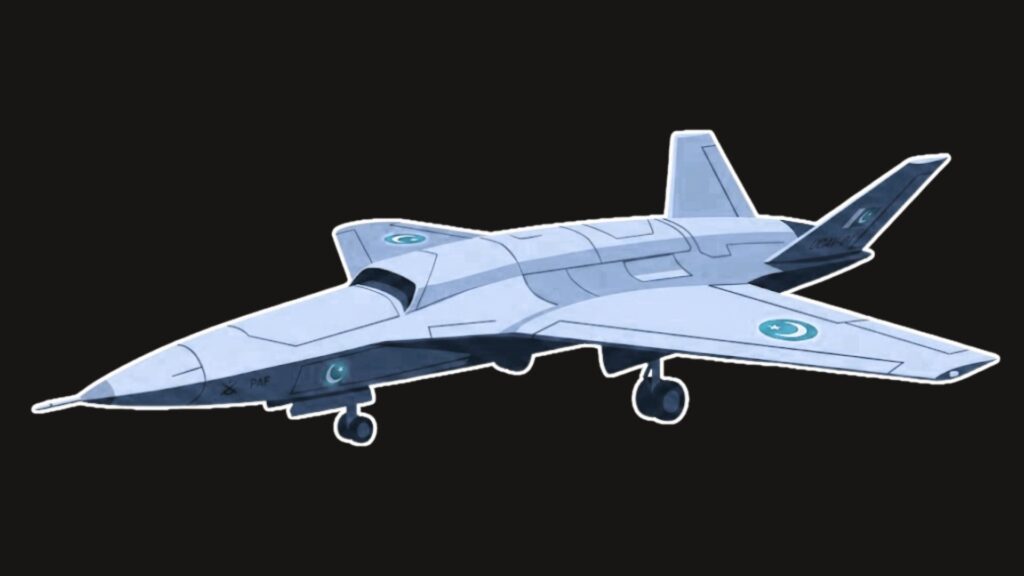
A pragmatic alternative to a fifth-generation fighter is taking shape — and a 2021 Quwa analysis predicted much of it. A new Pulse Check episode revisits the argument with the benefit of hindsight.
For more than a decade, Pakistan’s ambition to field a homegrown stealth fighter under Project Azm has run up against an uncomfortable reality: the country’s aerospace base is not yet built for it. Now, a growing body of analysis suggests the Pakistan Air Force (PAF) may reach its next leap in air power not through a crewed fifth-generation jet, but through a family of stealthy unmanned combat aerial vehicles (UCAVs) — and that Türkiye’s Baykar could be central to getting there.
That is the throughline of the latest episode of Pulse Check, Quwa’s subscriber podcast, in which editor-in-chief Bilal Khan and contributor Syed Aseem Ul Islam — a flight-control researcher at the University of Michigan — return to a roadmap Aseem first laid out for Quwa in 2021. The original article, How Pakistan Can Design a Loyal Wingman Drone, has now been republished and ungated, and reads as an early sketch of a debate that has since moved to the centre of South Asian air-power planning.
Finish the story. Get the full picture.
Unlock independent journalism and deeper analysis on Pakistan’s key defence and policy developments
A Pragmatic Pivot from Project Azm
Project Azm was conceived as Pakistan’s pathway to a fifth-generation fighter and supporting technologies. But the leap from co-producing the JF-17 Thunder to designing a stealth aircraft skips several stages of industrial capability that Pakistan has not yet acquired, the analysis argues.
The proposed alternative is incremental. Rather than chase a crewed stealth jet, the Pakistan Aeronautical Complex (PAC) would develop a “loyal wingman” — an uncrewed aircraft that flies alongside fighters, absorbs risk, and multiplies the number of sensors and weapons in the air. The aim is not to replace the ambition behind Project Azm, but to build toward it through a programme the country can realistically execute.
The ‘Vafadar’ Family: Two Drones, One Roadmap
Aseem’s 2021 proposal envisioned two complementary UCAVs, named Vafadar-1 and Vafadar-2 — a deliberately on-the-nose play on the word “loyal.”
The smaller Vafadar-1 was framed as a low-cost, attritable platform in the two-to-three-tonne class: a high-subsonic drone powered by an engine in the class of the Honeywell TFE731 — the same powerplant used by the K-8 trainer — with an internal weapons bay, rocket-assisted takeoff, and a combat radius of roughly 700km. The larger Vafadar-2 was sketched as a heavier, more capable design powered by an overhauled, afterburner-free RD-93, the engine already integrated on the JF-17, for the sake of commonality.
Both drones shared a common backbone: a network-centric design capable of connecting to Link 16 and Pakistan’s indigenous Link 17, autonomous takeoff-to-landing modes, and the ability to receive high-level commands from a controlling fighter without overloading its pilot. In the podcast, the authors concede some of the original engine and weight figures now look like overshoots, given how Turkish, American and Chinese drones have actually matured. The direction of travel, however, has held up.
Why the Moment has Arrived — Baykar and the Kizilelma
What has changed since 2021 is the supplier landscape. Baykar, the Turkish manufacturer behind the combat-proven Bayraktar TB2, now markets the jet-powered Bayraktar Kizilelma — a recoverable, fast UCAV that sits close to the “drone fighter” concept anticipated by Vafadar-2.
The Kizilelma is no longer hypothetical as an export product. Baykar has signed its first Kizilelma export contract with an Indonesian partner, with deliveries expected starting in 2028 and options for additional aircraft.
Pakistani interest, meanwhile, has been signalled at the highest level: Chief of Air Staff Air Chief Marshal Zaheer Ahmed Baber Sidhu was photographed in front of a Kizilelma during a visit to Türkiye, and Quwa has tracked a series of indicators pointing to PAF engagement with the platform.
For the analysts, Baykar’s appeal is not only its catalogue but its willingness to co-develop unconventional systems with the PAF — a flexibility that has produced loitering munitions such as the Yiha and Kamikaze families, and that may distinguish it from more conservative competitors.
The Gap in Türkiye’s Catalogue
The more striking argument in the episode concerns the smaller drone. While Türkiye’s manufacturers have concentrated on six-to-seven-tonne designs, neither Baykar nor Turkish Aerospace has fielded a dedicated two-to-three-ton stealth UCAV — a class the United States is pursuing through no fewer than three or four parallel efforts, including Kratos’ XQ-58A Valkyrie, General Atomics’ contender, and Anduril’s Fury under the Collaborative Combat Aircraft programme.
That, Khan argues with deliberate caution, is the opening. He puts it at roughly 90 percent likelihood that the PAF and Baykar will jointly develop a two-to-three-tonne stealth UCAV to fill the gap — a platform that could then be offered to Baykar’s existing global customer base as TB2-era drones age against improving air defences.
Reference Link:- https://quwa.org/podcasts/pulse-check/analysis-how-pakistan-can-build-a-stealth-loyal-wingman-drone/