

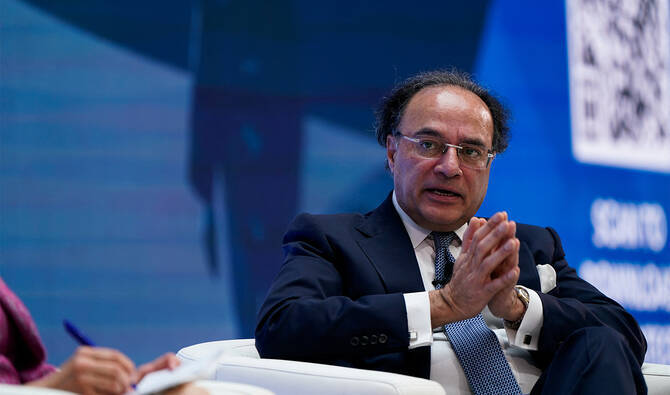

Pakistan Finance Minister Muhammad Aurangzeb participates in a panel titled “Navigating an Uncertain World” during the 2025 annual IMF/World Bank Spring Meetings in Washington DC, US, April 25, 2025. (REUTERS/File)
- Finance minister says forex reserves to hit $18 billion by June amid reform push
- Government touts tariff cuts, privatization and crypto regulation to attract investment
Pakistan pitched its economic recovery and reform agenda to European businesses and investors on Tuesday, with Finance Minister Muhammad Aurangzeb saying the country’s foreign exchange reserves were expected to rise to $18 billion by June as macroeconomic stability improves.
Speaking at the EU-Pakistan Business Forum in Islamabad, Aurangzeb outlined what he described as a broad economic turnaround driven by fiscal consolidation, current account surpluses, export growth and structural reforms aimed at attracting foreign investment.
Pakistan has been attempting to stabilize its economy under a $7 billion International Monetary Fund (IMF) program after years of high inflation, dwindling reserves and balance-of-payments pressures. The government is now seeking to shift the narrative from crisis management to investment and long-term growth, particularly as it courts international investors at a time of global economic uncertainty.
“We are quite clear that our reserves are going to be at $18 billion at the end of June,” Aurangzeb said.
He said Pakistan’s economy was expected to grow by around 4 percent in the current fiscal year, up from 3.1 percent a year earlier, while the country had also recorded a current account surplus during the first nine months of the fiscal year.
Aurangzeb said remittances remained strong and information technology exports were continuing to support external accounts, alongside gains in higher value-added exports.
The minister also pointed to lower debt servicing costs despite the State Bank of Pakistan’s decision this week to raise interest rates by 100 basis points to 11.5 percent in response to inflation risks linked partly to higher global energy prices.
Much of Aurangzeb’s address focused on structural reforms aimed at improving competitiveness and reassuring foreign investors about Pakistan’s business environment.
He said the government had reduced tariffs and duties on intermediate goods and raw materials to help make local industries more export competitive.
“We said we are going to bring down our tariff regime… so that our industry actually gets competitive,” he said.
Aurangzeb also reiterated the government’s commitment to privatization, saying Pakistan was moving ahead with plans involving airports, electricity distribution companies and state-owned enterprises following renewed momentum in the privatization of the national airline, Pakistan International Airlines.
“The private sector has to lead the country,” he said.
The minister said Pakistan had also returned to international debt markets after a four-year gap and was in the final stages of launching its inaugural Panda bond, a yuan-denominated bond issued in China’s domestic market, and expected the issuance to be completed by mid-May if all went according to plan.
Toward the end of his remarks, Aurangzeb highlighted Pakistan’s growing crypto economy, saying authorities had moved to regulate the sector after discovering the scale of digital asset usage in the country.
“We had 40 million crypto users in Pakistan,” he said, adding that the government was now in advanced stages of issuing licenses under a new regulatory framework.
Aurangzeb framed the reforms as part of a broader economic transformation, saying international institutions had compared Pakistan’s current trajectory to the early stages of Southeast Asia’s export-led growth.
“This can very well be our South Asia moment,” he said.
Reference Link:- https://www.arabnews.com/node/2641551/pakistan