

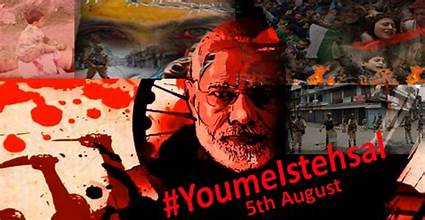
EACH year, October 27 casts a long shadow over the Himalayan valley of Kashmir—a day etched in memory as the beginning of an occupation that continues to defy justice, peace and the aspirations of millions.
On this date in 1947, Indian troops landed in Srinagar, marking the start of a military presence that has since evolved into one of the world’s most protracted and volatile territorial disputes. For Kashmiris, it is not merely a historical footnote—it is a living wound. For Pakistan and the global community, it is a test of moral clarity and diplomatic resolve.
A Day of Betrayal and Beginning: October 27 is observed as “Black Day” by Kashmiris across the globe. It commemorates the moment when India, invoking the controversial Instrument of Accession, deployed its forces into Jammu and Kashmir. The move, made under the pretext of repelling tribal incursions, was never ratified by a plebiscite—a promise enshrined in UN resolutions and echoed by India’s own leadership at the time. The consequences were immediate and enduring: decades of militarization, curfews, disappearances and a systematic erosion of civil liberties. The valley, once romanticized as a paradise, became a crucible of resistance and repression.
As Allama Iqbal, whose ancestral roots lie in Kashmir, lamented: “Aaj woh Kashmir hai mahkoom-o-majboor-o-faqeer, Kal jise ahl-e-nazar kehte thay Iran-e-sagheer.” Today, Kashmir is oppressed, helpless and destitute—once hailed by the wise as Little Iran. Iqbal’s words pierce through time, reminding us that Kashmir’s descent into despair was neither inevitable nor irreversible. The Anatomy of the Imbroglio: The Kashmir conflict is not merely a bilateral dispute between India and Pakistan—it is a human tragedy with geopolitical reverberations. The imbroglio is sustained by three interlocking failures:
Diplomatic Paralysis: Despite multiple wars and summits, the issue remains unresolved. The Simla Agreement (1972) and Lahore Declaration (1999) offered frameworks, but lacked enforcement and sincerity. Demographic Engineering: Post-August 5, 2019, India’s unilateral revocation of Article 370 and 35-A intensified fears of demographic dilution and cultural erasure in Indian-occupied Kashmir. Global Apathy: The international community, preoccupied with strategic partnerships and economic interests, has largely failed to hold India accountable for human rights violations or to push for meaningful dialogue.
This triad of inertia, imposition and indifference has turned Kashmir into a geopolitical tinderbox—where the aspirations of its people are muffled beneath the weight of competing nationalisms. Reframing the Narrative: From Conflict to Dignity: To move beyond the impasse, we must first reframe the Kashmir issue—not as a territorial contest, but as a struggle for dignity, identity and democratic agency. This requires a shift in both rhetoric and policy: Cantering Kashmiri Voices: Any resolution must begin with the inclusion of Kashmiri stakeholders—across religious, regional and ideological lines. Their lived experiences and aspirations must shape the contours of peace.
Human Rights as a Non-Negotiable: The restoration of civil liberties, release of political prisoners and repeal of draconian laws like the Public Safety Act are prerequisites for trust-building. Demilitarization and Confidence-Building: A phased reduction of military presence, monitored by international observers, can create space for dialogue and reconciliation. Strategic Pathways to Resolution: While the road to peace is fraught, it is not impassable. Several proposals—some historical, others emerging—offer viable starting points:
Musharraf’s Four-Point Formula Revisited: General Pervez Musharraf’s 2007 proposal remains one of the most pragmatic frameworks: Soft borders with free movement across regions; Self-governance without independence; Gradual demilitarization; Joint supervision by India, Pakistan and Kashmiris. Though politically shelved, the formula offers a middle ground—balancing sovereignty concerns with autonomy aspirations. UN-Led Mediation and Plebiscite: Reviving UN resolutions and appointing a special envoy could re-legitimize the international legal framework. A phased plebiscite, preceded by normalization and demilitarization, remains the gold standard of democratic resolution.
Track II Diplomacy and Civil Society Engagement: Beyond state actors, peace-building must involve academics, journalists, Diaspora communities and cultural figures. Initiatives like cross-border tourism, academic exchanges and joint heritage projects can humanize the conflict and foster empathy. Economic Integration and Environmental Cooperation: Shared challenges—climate change, water management and disaster resilience—offer non-political entry points for collaboration. A Kashmir Peace Corridor focused on sustainable development could reorient the region from conflict to co-prosperity. Pakistan’s Role: Stewardship, Not Sabre-Rattling: For Pakistan, the Kashmir cause is not merely a diplomatic priority—it is a moral imperative. But stewardship must replace sabre-rattling. This means:
Championing human rights through international forums; Supporting Kashmiri civil society and media; Investing in strategic storytelling that highlights the cultural, poetic and historical richness of Kashmir; Pakistan must also ensure that its own administered regions of Kashmir are models of transparency, development and democratic inclusion—lest its moral claim be undermined by internal contradictions.
Conclusion: From black day to bright horizon: October 27 will always be a day of mourning for Kashmiris. But it can also be a day of reckoning—a moment to renew our commitment to justice, dignity and peace. As Faiz Ahmad Faiz wrote in Subh-e-Azaadi, a poem often evoked in the context of Kashmir’s deferred dreams: “Yeh woh seher to nahin jis ki aarzu le kar, Chalay thay yaar ke mil jaayegi kahin na kahin.” This is not the dawn we had longed for, the one we set out to find. Kashmir is not a chessboard—it is a homeland. Its people are not pawns—they are protagonists. And their story deserves not just remembrance, but resolution.
Reference Link:- https://pakobserver.net/kashmir-memory-mandate-moral-reckoning/