

Deputy Prime Minister/Foreign Minister Ishaq Dar has said that Pakistan wants a peaceful solution to all disputes in the South China Sea and believes in One China regarding the question of Taiwan. As we also commemorate the 50th anniversary of the Treaty of Amity and Cooperation in Southeast Asia, Pakistan stands firmly committed to its cardinal principles of dialogue, mutual respect, and peaceful coexistence.
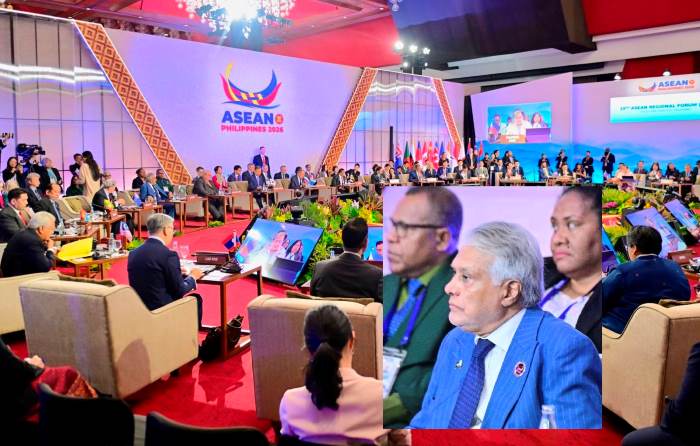
He expressed these views in his address at the 33rd ASEAN Regional Forum (ARF) Ministerial Meeting, Manila, Philippines, 23 July 2026.
Mr. Dar said, Pakistan deeply values ASEAN’s consensus-based approach and supports stronger cooperation to address both traditional and emerging challenges.
” As ARF brings together countries from diverse regions, let me highlight eight (08) key challenges that continue to threaten peaceful coexistence, stability, and our livelihoods across the region and the world. Any delay in addressing these challenges will only undermine our collective efforts to achieve peace, stability, and prosperity across our regions and beyond, he noted.
Here are the key points of his address in detail ;
Over the past few decades, the ASEAN Regional Forum has established itself as an indispensable pillar of the regional security architecture. In an increasingly complex strategic environment, it must continue to strengthen its preventive diplomacy role by remaining dynamic, forward-looking, and focused on practical action. We, therefore, welcome the adoption of the Manila Plan of Action (2026–2036) and reaffirm Pakistan’s commitment to its effective implementation.
We meet at a time when geopolitical uncertainties are placing increasing pressure on multilateral institutions and undermining the rules-based international order. Pakistan deeply values ASEAN’s consensus-based approach and supports stronger cooperation to address both traditional and emerging challenges, including artificial intelligence, cybersecurity, climate change, food and energy security, disaster resilience, and public health preparedness. ARF must continue to promote dialogue, practical cooperation, and strengthen its capacity to address evolving regional and global security challenges.
Developments in South Asia continue to exacerbate serious security challenges to peace and stability. The continued failure to resolve long-standing disputes, particularly the Jammu and Kashmir dispute between India and Pakistan, remains at the heart of regional instability. Pakistan continues to advocate a just and peaceful settlement in accordance with the UN Charter, relevant Security Council resolutions, and the aspirations of the Kashmiri people.
We also remain deeply concerned by India’s illegal unilateral decision to place the Indus Waters Treaty in abeyance, seeking to weaponize water resources in violation of its international obligations. This threatens the lives and livelihoods of 240 million people in Pakistan. We cannot afford to let this serious, provocative development remain unaddressed.
Let us all be the architects of peace and stability, and work together to address the challenges posed by arbitrary, illegal, unilateral actions. We, therefore, urge the entire international community, particularly the ARF membership, to support a peaceful resolution of these core issues and uphold international law.
South China Sea & Taiwan
On the South China Sea, Pakistan supports the peaceful settlement of all disputes in accordance with the purposes and principles of the UN Charter. We value our ties with all Asia-Pacific states and urge that these disputes be resolved through dialogue, diplomacy, and mutual respect.
Peace in this vital region necessitates non-interference, restraint, and engagement. Pakistan reiterates its firm commitment to the One-China Principle, recognizing the People’s Republic of China as the sole legitimate authority over Taiwan.
Gulf Crisis
The unfortunate developments in the Gulf region have seriously impacted all of our countries. We cannot afford to ignore these developments. Therefore, Pakistan did everything within its capacity to help restore peace and stability in the region, and continues to do so. We played our role in facilitating the ceasefire, convening the Islamabad Talks at the leadership level between the two countries after 47 years, followed by the signing of the Islamabad Memorandum of Understanding in Burgenstock. We deeply appreciate the confidence entrusted in Pakistan by the United States, Iran, Gulf countries, and all our friends to steer these efforts.
These hard-earned achievements through dialogue and diplomacy have created a valuable opportunity to advance lasting peace. We must not let this opportunity slip through our hands. Pakistan remains committed to making every effort to establish peace and stability in the region.
Pakistan urges all parties to exercise restraint, uphold their commitments, and pursue peaceful engagement. We remain hopeful that these efforts will contribute to regional stability, the reopening of the Strait of Hormuz, and the resumption of normal shipping. The international community must continue to support and reinforce these efforts through sustained dialogue, diplomacy, and constructive engagement to help achieve lasting peace and stability in the region and beyond.
Gaza and Palestine
The humanitarian situation in the Occupied Palestinian Territory, particularly Gaza, remains deeply alarming. Our collective failure to prevent the genocidal streak unleashed in Gaza raises serious questions about our collective conscience as human beings and about our ability to prevent the continued atrocities in the region.
Pakistan reiterates its unwavering support for the inalienable right of the Palestinian people to self-determination and for the establishment of an independent, sovereign, viable, and contiguous State of Palestine, based on the pre-1967 borders, with Al-Quds Al-Sharif as its capital.
Terrorism
Terrorism remains a common threat and challenge for all of us in varying degrees. Pakistan has been at the frontline of the global fight against terrorism. No country outside active conflict zones has made sacrifices comparable to Pakistan. We have paid an enormous price in this fight, with over 80,000 precious lives and colossal economic losses.
Pakistan continues to confront terrorist threats, including those originating from across our borders and supported by both non-state actors and state sponsors. Our comprehensive counterterrorism strategy combines kinetic operations with educational reform, institutional resilience, and enhanced cooperation to address the evolving cyber dimension of terrorism.
Despite all odds, Pakistan is determined to fight against terrorism in all its forms and manifestations. This is a long-term commitment that requires sustained national efforts and enhanced international cooperation. We see it as a fight for the safety and security of our own state, as well as for greater peace and stability of the world, amounting to over US$ 150 billion.
Afghanistan
The threat posed by terrorist groups operating from Afghan soil continues to pose a serious security challenge to our region. Tehrik-i-Taliban Pakistan (TTP)/Fitna-al-Hindustan and Baloch Liberation Army (BLA)/Fitna-e-Khawarij continue to exploit Afghan territory to launch attacks against Pakistan.
Pakistan has only one expectation from the Afghan Taliban regime: Do not allow Afghan territory to be used for terrorism against Pakistan. If they can honour these commitments and fulfil their repeated promises, there will be immense opportunities for trade, connectivity, and socio-economic development across South Asia, Central Asia, and beyond.
DPM/FM Pakistan called upon the Afghan Taliban regime and all abettors of terrorism in the region to refrain from allowing Afghan territory to be used against its neighbours or anyone else. I also urge ARF members to support efforts aimed at ensuring that Afghan territory is not used to threaten regional peace and security.
Ukraine
Pakistan supports all diplomatic efforts aimed at achieving a just and lasting peace in Ukraine. We remain steadfast in our commitment to the principles of the UN Charter, including sovereignty, territorial integrity, the peaceful settlement of disputes, and the non-use of force. Dialogue and diplomacy remain the only sustainable path to peace.
Climate Change
Pakistan remains among the countries most vulnerable to climate change. We are pursuing an ambitious climate agenda, including expanding clean energy and implementing our Nationally Determined Contributions.
He called for enhanced international cooperation, guided by the principle of common but differentiated responsibilities and respective capabilities, to address this common global challenge.
To conclude, he reiterated that Pakistan remains firmly committed to the objectives and principles of the ASEAN Regional Forum. As we move forward, let us renew our collective resolve to build a peaceful, inclusive, and resilient region where sovereign equality, mutual respect, and dialogue remain the foundation of our shared future. Let us work together to build a peaceful, prosperous, and resilient future for all.