


The Israeli military has previously accused some Palestinians of ignoring the warning not to approach the ceasefire positions and troops
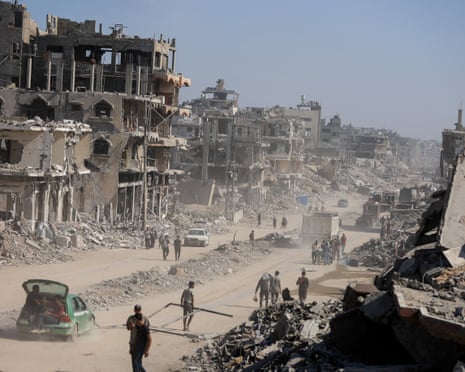
Tom Ambrose and Joe CoughlanThu 16 Oct 2025 17.08 BSTShare
The Guardian’s expert news coverage is funded by people like you, not a billionaire owner. Readers who choose an All-access digital subscription make the most impact and enjoy great benefits in return. Will you join them today?
Hamas accuses Israel of breaching ceasefire by ‘killing at least 24 people’ since Friday
A senior Hamas official on Thursday accused Israel of flouting the ceasefire by having killed at least 24 people in shootings since Friday, and said a list of such violations was handed over to mediators, Reuters reports.
He said:
The occupying state is working day and night to undermine the agreement through its violations on the ground.
The Israeli military did not immediately respond to the Hamas accusations. It has previously been said that some Palestinians have ignored warnings not to approach Israeli ceasefire positions and troops “opened fire to remove the threat”.
A row over the return of bodies of hostages held by Hamas in Gaza retains the potential to upend the truce, along with other major planks of the plan yet to be resolved, including disarmament of militants and Gaza’s future governance.
Israel demanded that Hamas fulfil its obligations in turning over the unrecovered bodies of all 28 hostages who died during the war. The Islamist faction said it had handed over 10 bodies but Israel said one of them was not that of a hostage.
“We will not compromise on this, and we will spare no effort until our fallen hostages return, every last one of them,” Israel’s government spokesperson said on Wednesday.
The armed wing of Hamas said the handover of more bodies in Gaza, which was reduced to vast tracts of rubble by the war, would require the admission of heavy machinery and excavating equipment into the Israel-blockaded Palestinian territory.Share
Closing summary
- Gaza’s Rafah crossing with Egypt will probably be reopened on Sunday, Israel’s foreign minister Gideon Sa’ar was quoted as saying by Italian news agency ANSA on Thursday. “We are making all the necessary preparations,” Sa’ar was quoted as saying at a conference on the Mediterranean region, being held in Naples.
- Israeli government spokesperson Shosh Bedrosian told reporters on Thursday that Israel remained committed to the ceasefire agreement and continued to uphold its obligations, Reuters reports. He also demanded that Hamas return the bodies of the 19 deceased hostages it had not handed over.
- International Monetary Fund managing director Kristalina Georgieva on Thursday urged all parties to continue moving in the direction of a sustained, lasting peace after a ceasefire in Gaza, saying it would benefit the entire region, Reuters reports.
- A senior Hamas official on Thursday accused Israel of flouting the ceasefire by having killed at least 24 people in shootings since Friday, and said a list of such violations was handed over to mediators. The Israeli military did not immediately respond to the Hamas accusations. It has previouslybeen said that some Palestinians have ignored warnings not to approach Israeli ceasefire positions and troops “opened fire to remove the threat”.
- Israel returned the bodies of 30 Palestinians to Gaza on Thursday, bringing the total number handed over to 120, the Hamas-run health ministry and Nasser hospital in Khan Younis said. Under a ceasefire deal brokered by US President Donald Trump, Israel was to turn over the bodies of 15 Palestinians for every deceased Israeli returned.
- Hamas has announced that the remains of all the deceased Israeli hostages that it can reach have been handed back, and it would need specialist recovery equipment to retrieve the rest from Gaza’s ruins, amid threats from Israel to resume fighting if the terms ofthe ceasefire are not honoured. Two further bodies were handed over late on Wednesday, after Hamas had already returned the remains of seven of 28 known deceased hostages – along with an eighth body which Israel said was not that of a former hostage.
- Israel’s military aid agency COGAT told Reuters on Thursday that preparations are ongoing with Egypt to open the Rafah crossing for the movement of people, but the date for the opening will be announced at a later stage. Israel had earlier warned it could keep Rafah shut and reduce aid into the Palestinian territory as Hamas, it said, was returning the bodies of dead hostages too slowly, underlining the risks to a ceasefire that halted two years of devastating war and saw all living hostages held by Hamas released.
- Israel’s National Institute of Forensic Medicine on Thursday identified the remains of two more hostages returned from Gaza, as officials and families warned Hamas to hand over the bodies of those still held. The Israeli military said the bodies were those of Nova music festivalgoer Inbar Hayman and Sgt. Muhammad al-Atresh, who was killed in fighting on 7 October 2023, when Hamas-led militants attacked Israel, igniting the war.
- Pope Leo XIV on Thursday cited Gaza as an example of the world’s failure to stop millions of people from going hungry, blaming a “soulless economy” and calling on people to rethink their lifestyles and priorities. The crisis was “a clear sign of a prevailing insensitivity, a soulless economy,” Leo told the Food and Agriculture Organization (FAO) at an event to mark its 80th anniversary.
Gaza’s Rafah crossing with Egypt will probably be reopened on Sunday, Israel’s foreign minister Gideon Sa’ar was quoted as saying by Italian news agency ANSA on Thursday.
“We are making all the necessary preparations,” Sa’ar was quoted as saying at a conference on the Mediterranean region, being held in Naples.
He did not specify whether the crossing would be opened for the passage of humanitarian aid or for people.
From the clean soft sands of Zikim beach or its sky-blue and turquoise waters, where on Thursday, waves gently lapped against the thighs of cheery middle-aged women, one can see a different world.
Looking past the tall iron fence that marks the end of the beach, the outlines of what is left of Gaza’s Beit Lahia resort are clearly visible less than 2 miles south down the coast – as are the watchful Israeli destroyers out to sea.
On 7 October 2023, Hamas gunmen used speedboats to land on Zikim with the goal of capturing the nearby military training base.
In the ensuing violence, 17 civilians were killed on the beach, including fishers, teenagers on a camping trip and a group that had held a beach party the previous night.
The beach and its burnt-out showers, shelters and lifeguard tower, were closed off to the public by the Israeli military.
Work started in March to rebuild the facilities to the background noise of Israel’s bombardment of Gaza, which has killed an estimated 67,000 Palestinians, most of whom were civilians.
Understanding what is happening in the Middle East is more important than ever.
It’s the Guardian’s job to decipher this, and with reporters sharing live updates around the clock, including from inside Gaza, we’re well placed to provide comprehensive, fact-checked reporting, to help us all make sense of the events reshaping global politics. But we can’t do it without your support.
We appreciate that not everyone can afford to pay for news right now. That’s why we choose to keep our journalism open for everyone. If this is you, please continue to read for free. But if you can, can we count on your support at this perilous time?
Help power the Guardian’s journalism by supporting us every month and enabling us to keep our quality reporting open for everyone.
Palestinian Prime Minister Mohammad Mustafa said Thursday in Ramallah that the Palestinian Authority’s plan would build directly on an Arab-led initiative announced in March.
He stressed that rebuilding should be “anchored in Palestinian national ownership and leadership.” Israeli and US officials rejected that plan at the time.
Though he did not mention them directly, Mustafa’s remarks stood in contrast to proposals that would place Gaza under an internationally supervised transitional governance led by a technocratic, apolitical committee.
The Ramallah-based authority hasn’t controlled Gaza since Hamas seized power in 2007 and is mistrusted by both Israel’s right-wing government and many Palestinians.
Mustafa said the PA’s program aims to rebuild Gaza and better connect it with the occupied West Bank, which it currently administers. He said the plan includes restoring an estimated $67 billion in damage.
“Recovery will not only restore homes, schools, hospitals and infrastructure,” Mustafa said. “Hopefully, it will also restore hope for our people, strengthen governance, empower communities, and build resilience against future shocks.”
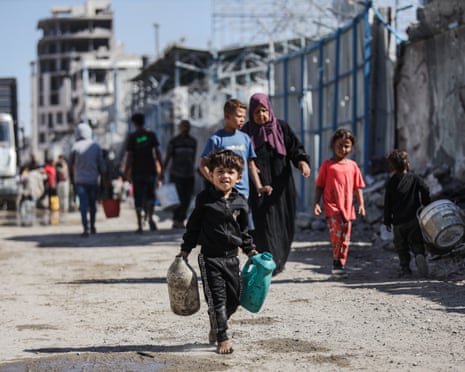
Palestinians walk past the rubble of destroyed buildings, amid a ceasefire between Israel and Hamas, in Gaza City, earlier today.
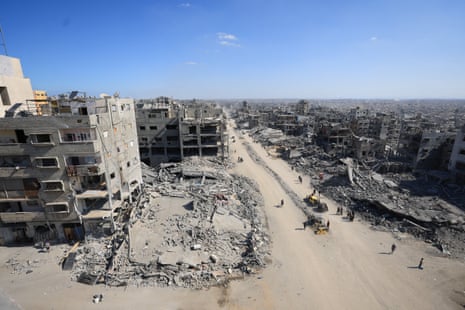
International Monetary Fund managing director Kristalina Georgieva on Thursday urged all parties to continue moving in the direction of a sustained lasting peace after a ceasefire in Gaza, saying it would benefit the entire region, Reuters reports.
Georgieva, speaking during the annual meetings of the IMF and World Bank in Washington, said she was relieved when the recent ceasefire was reached, noting that lowered tensions would be good news for the economies of Egypt and Jordan, where the IMF has programmes, and Lebanon and Syria, which have asked for help and support from the global lender.
She said:
It is important that everybody concerned encourages this direction of sustaining a lasting peace, and yes, it would benefit the region.

Dr Ofer Cassif is a member of the Knesset, representing the Democratic Front for Peace and Equality (Hadash) since 2019
Last Monday, when the US president, Donald Trump, addressed the Knesset alongside the Israeli prime minister, Benjamin Netanyahu, my compatriot lawmaker Ayman Odeh and I raised a banner calling them to “Recognise Palestine”. We were brutally expelled by force from the parliament’s plenum, revealing the fragile state of the supposed “only democracy in the Middle East”. How can Trump and Netanyahu speak of peace in the Middle East without recognition of the people deprived for decades of their basic liberties and rights under vicious occupation?
Nowhere is the deceit clearer than in the occupied West Bank. There, the words of peace are but a weak and distant voice, but the horrifying sounds of settler violence and terror still echo loudly. More than 30 occurrences of settler violence against Palestinians have been documented since the announcement of Trump’s 20-point plan at the end of September, including physical assaults, theft of agricultural produce and torching of vehicles and property.
The rise of settler terrorism is not coincidental. This period marks the start of the harvest season. More than a vital economic event, it is an important social and national moment that exhibits endurance under occupation. Precisely for these reasons, year after year, settlers target Palestinians during this precious time. During the 2024 harvest period, Yesh Din (an Israeli human rights group that collects and disseminates information regarding violations of Palestinians’ human rights in the West Bank) documented 113 separate incidents of violence, harassment, harvest-thwarting or damage to olive trees and crops involving Israeli civilians and soldiers, which took place on lands belonging to 51 Palestinian villages, towns and communities.
Yesh Din also found that “Israeli security forces appeared to have played a greater role in obstructing the olive harvest”. In about 70% of forceful prevention of access to lands, soldiers, border police officers and settlement civilian security coordinators (CSCs) were actually present. They either personally prevented Palestinians from accessing and harvesting in their own lands or failed to stop settlers who harassed or assaulted them.
This comes as no surprise, as the leader of the settlers’ political party, Bezalel Smotrich, was appointed as an additional minister in the Ministry of Defence in charge of the Coordinator of Government Activities in the Territories (COGAT). In Umm al-Khair, for example, a special COGAT unit uprooted private olive trees of Palestinians, citing lack of permits, but ignored violations of an illegal nearby settler outpost. Last week, the Jerusalem district court ruled to halt all building work in the outpost, which was built on lands seized by Israel and unlawfully transferred to settlers.
You can read the full piece from Dr Ofer Cassif here: While the eyes of the world are on Gaza, Israeli settlers in the West Bank still behave with impunity
Israeli government spokesperson Shosh Bedrosian told reporters on Thursday that Israel remained committed to the ceasefire agreement and continued to uphold its obligations, Reuters reports.
He also demanded that Hamas return the bodies of the 19 deceased hostages it had not handed over.
The comment comes after Israel returned the bodies of 30 Palestinians to Gaza on Thursday, bringing the total number handed over to 120, the Hamas-run health ministry and Nasser hospital in Khan Younis said.Share
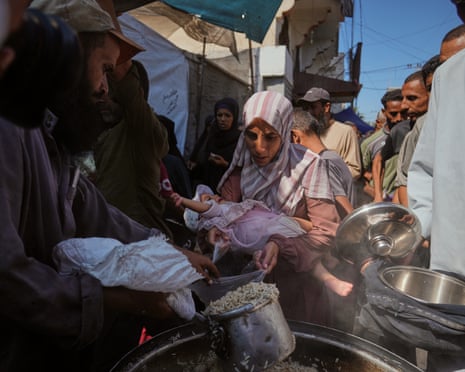
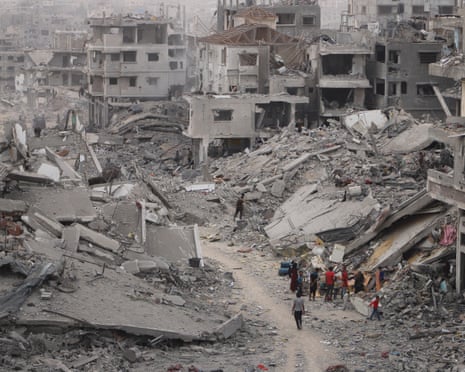
Below are some of the latest images from the Middle East coming to us through the wires:

A former Israeli hostage said on Thursday that all Gaza captives could have returned home “a long time ago”, as relatives of newly released hostages described the torment endured by their loved ones, Agence France-Presse (AFP) reports.
Arbel Yehud was held in captivity for nearly 500 days before being freed earlier this year under a previous Gaza truce.
She spoke on Thursday at a press conference alongside families of newly freed hostages, including her partner Ariel Cunio, released this week along with the remaining living captives.
We could have brought them back a long time ago.
While we are here, fortunate to embrace our loved ones, there are dozens of families that never will.
She added the deal that was brokered by US president Donald Trump could have been struck earlier, in turn saving the lives of more hostages.

A vocal critic of the Israeli government, Yehud has participated in rallies calling for a ceasefire and the return of hostages.
Earlier this year, she accused authorities of endangering captives by stalling negotiations.
Yehud’s own release in January was marked by chaotic scenes, with television footage showing masked gunmen struggling to clear a path for her through crowds gathered to witness the exchange
Yemen’s Houthis said on Thursday that their chief of staff Muhammad Abd Al-Karim al-Ghamari was killed, without further details.
Israel’s National Institute of Forensic Medicine on Thursday identified the remains of two more hostages returned from Gaza, as officials and families warned Hamas to hand over the bodies of those still held.
The Israeli military said the bodies were those of Nova music festivalgoer Inbar Hayman and Sgt. Muhammad al-Atresh, who were killed in fighting on 7 October, 2023, when Hamas-led militants attacked Israel, igniting the war.
Amid a fragile truce that paused the two-year war, Palestinians were awaiting a long-promised surge of aid into Gaza, and plans for an international force to deploy there were beginning to take shape.
Since Monday’s exchange, Hamas has returned 10 bodies, nine of which Israel’s military has identified as hostages. Israel said there were 28 total in Gaza before the exchange.
Afternoon summary
Here is an overview of today’s developments so far:
- A senior Hamas official on Thursday accused Israel of flouting the ceasefire by having killed at least 24 people in shootings since Friday, and said a list of such violations was handed over to mediators. The Israeli military did not immediately respond to the Hamas accusations. It has previously said some Palestinians have ignored warnings not to approach Israeli ceasefire positions and troops “opened fire to remove the threat”.
- Israel returned the bodies of 30 Palestinians to Gaza on Thursday, bringing the total number handed over to 120, the Hamas-run health ministry and Nasser hospital in Khan Younis said. Under a ceasefire deal brokered by US president Donald Trump, Israel was to turn over the bodies of 15 Palestinians for every deceased Israeli returned.
- Hamas has announced that the remains of all the deceased Israeli hostages that it can reach have been handed back and it would need specialist recovery equipment to retrieve the rest from Gaza’s ruins, amid threats from Israel to resume fighting if the terms of ceasefire are not honoured. Two further bodies were handed over late on Wednesday, after Hamas had already returned the remains of seven of 28 known deceased hostages – along with an eighth body which Israel said was not that of a former hostage.
- Israel’s military aid agency COGAT told Reuters on Thursday that preparations are ongoing with Egypt to open the Rafah crossing for the movement of people, but the date for the opening will be announced at a later stage. Israel had earlier warned it could keep Rafah shut and reduce aid into the Palestinian territory as Hamas, it said, was returning the bodies of dead hostages too slowly, underlining the risks to a ceasefire that halted two years of devastating war and saw all living hostages held by Hamas released.
- Pope Leo XIV on Thursday cited Gaza as an example of the world’s failure to stop millions of people going hungry, blaming a “soulless economy” and calling on people to rethink their lifestyles and priorities. The crisis was “a clear sign of a prevailing insensitivity, a soulless economy,” Leo told the Food and Agricultural Organization (FAO) at an event to mark its 80th anniversary.
Thaslima Begum is an award-winning journalist with a focus on women, conflict and human rights
In June 2024, an Israeli missile struck 13-year-old Mazyouna Damoo’s apartment in Nuseirat refugee camp in central Gaza, hurling her and her mother into the street.
Her younger sister, Tala, was pulled from beneath the rubble alive, but her other siblings – Hala, 13, and Mohannad, 10 – were killed instantly. Mazyouna survived, but half of her face was ripped off, leaving her jawbone exposed.
More than a year on, Mazyouna’s journey and ongoing recovery in a hospital in the US has become a rare story of hope from the two-year Gaza war that has now entered a ceasefire. But it was a recovery that almost never happened.
With Gaza’s hospitals overwhelmed and unable to provide advanced reconstructive surgery, her family’s pleas last year for evacuation became desperate. For months, her parents appealed to the Israeli body overseeing humanitarian permits to allow Mazyouna to leave Gaza for treatment. Each request was either ignored or rejected.
During this time, her wounds worsened, becoming infected, and fragments of shrapnel embedded in her face caused excruciating pain. After the Guardian reported on her ordeal, Israel finally permitted her to leave to get surgical care.
 Israel and Hamas trade accusations as tensions rise over hostages’ remains
 Body handed over by Hamas is not hostage, says Israel, as Palestinian dead ‘arrive back in cuffs’
 Israel urged to open more Gaza border crossings to allow surge of aid
 Trump says Hamas will be forced to disarm or ‘we will disarm them’
 What issues are still to be resolved in the Gaza ceasefire deal?
 ‘I am the only one that matters’: Trump deals praise and insults at Gaza summit
 Families of dead hostages urge US to ‘leave no stone unturned’ to have them returned
 Israelis and Palestinians celebrate as truce brings hope of ‘era of peace’
 ‘I’m shaking all over’: hugs, tears and relief in Israel as Gaza hostages return
 ‘Locked up for 24 years’: release of Palestinian prisoners and detainees sparks joy
Reference Link:- https://www.theguardian.com/world/live/2025/oct/16/gaza-ceasefire-israel-hamas-palestine-rafah-hostages-live-news-updates