


A jade pendant bearing a small golden Sanxingdui mask rested against dancer Wu Yufei’s chest as he stepped onto the stage of the “America’s Got Talent” finale. Commissioned by his wife, this piece of home was by his side as he wowed the audience.
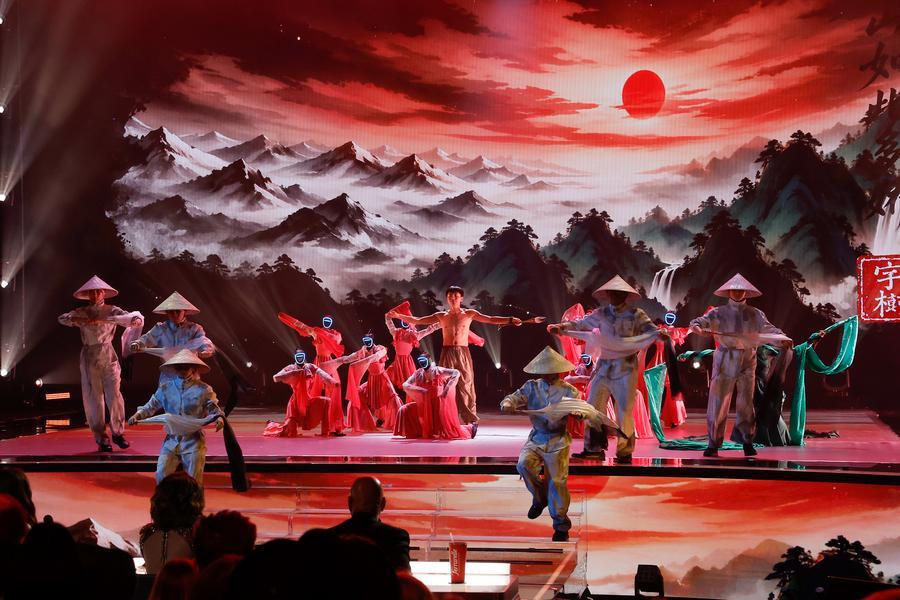
At the finale, 27-year-old Wu, from Sichuan Province in southwestern China, shared the stage with humanoid robots made by Unitree, performing in a fusion of robotics, ink-wash aesthetics, and contemporary stage performance.
“Robots are not merely technological achievements, but can also become creative partners on stage and a new medium for artistic expression,” said Fang Zhenghua, the Chengdu choreographer who directed the team’s performances.
Wu said their experience in the United States has been genuinely heartwarming. He, along with Fang, showcased not only the advances in humanoid robot technology but also young people’s vision of the future relationship between technology and humanity, adding that audiences are incredibly enthusiastic.
At their audition, Wu performed alongside machines that danced and flipped in time with the music. The act received a unanimous yes from all four judges.
By the Sept. 8 quarterfinals, Wu and the robots were performing martial arts alongside human dancers, kicking and flipping across the stage.
Judge Howie Mandel imagined a martial arts version of the film “I, Robot” and predicted it would be “the most viral moment we’re going to have this season.” Actress Sofia Vergara pressed her Golden Buzzer, sending the team directly to the Sept. 22 final.
For Wu, however, some of the most memorable exchanges happened away from the machines.
This marked his fourth trip to the United States. He had met several American dancers on past trips from the East Coast to the West Coast of the country. They made dance videos together on American streets, capturing times when they moved and played music together.
“Dance is a universal language,” he said.

When he made it to the finale, some of those friends reached out on social media to wish him luck. He also received encouraging messages from local viewers he had never met.
“Even though we come from different countries and speak different languages, at that moment they were sincerely wishing me well in the competition,” Wu said. “That stayed with me. It felt quite warm.”
Wu grew up visiting the Sanxingdui Ruins, a site associated with the ancient Shu Kingdom dating back some 3,000 to 4,500 years. He said visiting the site was “like going to a park.” During the contest, he brought one of those familiar faces across the Pacific, jokingly calling it a “mysterious force from the East.”
For Fang, inspiration also comes from familiar stories and everyday life. Over the years, his team has incorporated elements like Sichuan opera face-changing, the traditional Chinese composition “A Hundred Birds Paying Homage to the Phoenix,” and Three Kingdoms stories into the performances.
For the finale, choreographer Fang wanted to share a Chinese aesthetic that overseas audiences might know less well than kung fu. Water sleeves offered one way to do that, with robots becoming partners in expressing an old art form.
Wu’s appearance came in a year when American audiences encountered Chinese creativity in several different settings. In July, Chinese artists joined the Hollywood Film Music Orchestra for a “Black Myth: Wukong” concert in Los Angeles, while Lincoln Center expanded its previous Shanghai Day celebration into Chinese Arts Week. September brought Chinese dance dramas, including “Dream of the Red Chamber,” to New York.
On the final stage, flowing sleeves and humanoid robots brought something of China to American viewers, and the friendship had also become part of the story that Wu and his performers would take back home.
Reference Link:- https://english.news.cn/20261004/030919a4513d417dbcbaf44d48e9f387/c.html